
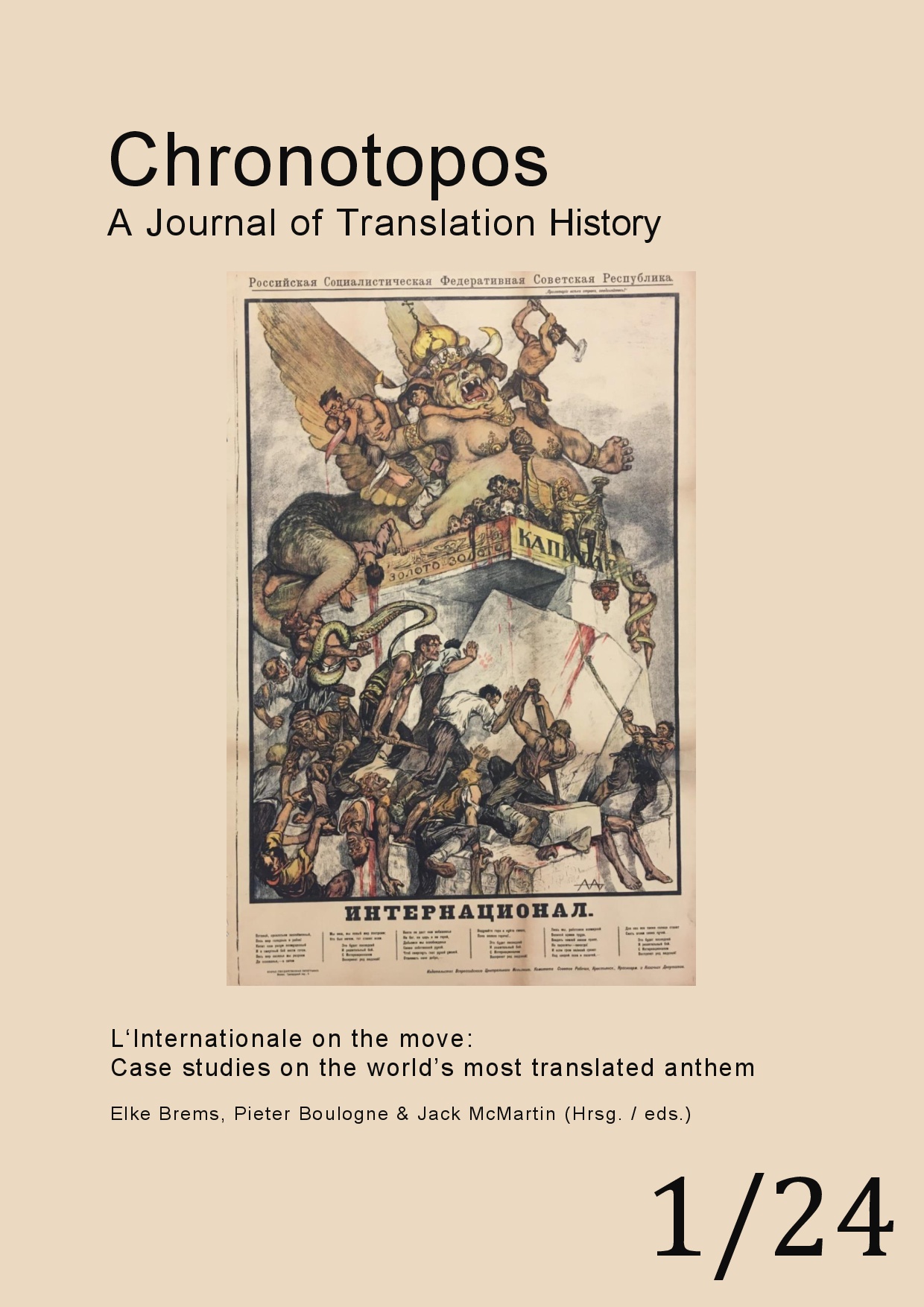
Together with Elke Brems and Jack McMartin I had the pleasure to guest edit a focus issue of the journal Chronotopos, titled “L‘Internationale on the move: case studies on the world’s most translated anthem,” which today has been published in open access.
Just over a hundred and fifty years ago, Paris was taken over by insubordinate soldiers of the National Guard. They attempted to create a new political system, a working-class community, which separated church and state, introduced social housing, abolished child labour, and gave employees the right to take over abandoned enterprises. After two months, this Paris Commune was violently ended by the French army. But the dream of addressing social injustice would not be forgotten. Immediately after the defeat of the Commune, one of its members, Eugène Pottier, commemorated it in a poem, written in French, which he named “L’Internationale”. In 1888, the Belgian socialist and composer Pierre De Geyter set Pottier’s poem to music. “L’Internationale”, previously a poem, was (re)born a song.
If the song “L’Internationale” has since become and still is a worldwide symbol of social struggle, it is because it was translated and often retranslated into dozens of languages and made to serve in many contexts. Our focus issue presents new research on versions of “L’Internationale” in different languages, historical contexts, social settings and media and explores the transnational and transmedial links between them. In doing so, we want to demonstrate how insights from (song) translation studies, reception studies, cultural memory studies and social history can be combined productively to explore the worldwide circulation and myriad social uses of one of the world’s most iconic, impactful and widely translated songs.
My own article, titled “Translated by Arkadiy Kots” Weaponization, Consecration, Monumentalization and Reincarnation of the Russian “Internationale”, deals with the impact of Arkadiy Kots as the translator of “L’Internationale” on Russian society. His Russian song translation, which emerged as a product of the counterculture, was first weaponized by Lenin to motivate workers to engage in the Russian Revolution. Then, it became the object of consecration: it was made the first anthem of the Soviet Union. However, with the passing of time, the song became an ideological and diplomatic issue, which under Stalin was solved by its monumentalization. As an established monument, Kots’s translation remained a fixture in Soviet culture until the very collapse of the empire. It is obvious that the failure of the Soviet experiment heavily damaged Kots’s cultural value. Nevertheless, his song translation remains present in post-Soviet Russia as the anthem of the Communist Party of the Russian Federation. At the same time, Kots also serves as an inspiration for the protest band that under his name has translated “L’Estaca”, which, as the most popular protest song of our time, could be seen as a reincarnation of “L’Internationale”.
These are the other articles included in our special issue:
Elke Brems & Francis Mus: The poetic, the personal and the political. Two Dutch translations of “L’Internationale”
Laura Cernat: Sinister Ironies. The Romanian translation of “L’Internationale” from an anthem of the oppressed to the last words of a tyrant
Erwin Snauwaert: “L’Internationale” and its Spanish Versions. Between Translation and Adaptation
Jan Ceuppens: “Die Internationale”: from Protest Song to Official Anthem and Back. Aspects of the German Reception of “L’Internationale” in the Early 1900s and After 1945
Christophe Declercq: “You have nothing if you have no rights” Reiterations of communal freedom through Billy Bragg’s translation of “The Internationale”
Jack Mc Martin: Representing translation in a documentary about one of the world’s most translated songs ‘Translatedness’ in Peter Miller’s The Internationale (2000)
You can read the full issue here.
Many thanks to all contributors, and to Stefanie Kremmel for her meticulous coordination of this issue.
 Van Poesjkin tot Poetin en snel terug