

This banner reads: “Belgian waffles are tasty, but for us, nothing is sweeter than domestic reform.” Following the tragic collapse of Novi Sad railway station in November 2024, Serbian students—both in Serbia and abroad—have begun protesting against the violent and corrupt government of President Aleksandar Vučić. In recognition of their efforts to restore democratic hope, one week ago, they were nominated for the Nobel Peace Prize.
Yet, the institutions of the European Union, eager to maintain business ties with Vučić, have remained silent, offering no support to the Serbian students—not even a symbolic one. This inaction is emblematic of their broader attitude. A case in point: on February 5, the European Parliament screened the movie “Not In My Country: Serbia’s Lithium Dilemma,” which sparked considerable discussion among Serbian students.
In “Not In My Country,” Peter Tom Jones, director of SIM² KU Leuven—the Institute for Sustainable Metals and Minerals—stars as an investigator, posing two central questions (as summarized in the film’s synopsis): “Is Serbia merely an EU mining colony, sacrificing its environment so wealthy Europeans can drive oversized electric vehicles? Or is the Serbian population the target of a hybrid Russian warfare campaign designed to hinder Serbia’s EU membership aspirations?” It doesn’t take a genius to see this as a false dilemma.
I watched the film on Friday 7 February, on the website of Journeyman Pictures, and calling it a documentary would be generous. It is little more than a PR stunt—a promotional piece for its creator and the mining giant Rio Tinto (one of Peter Tom Jones’ partners). What’s worse, it’s extremely gentle for the corrupt Serbian government. This comes at the expense of countless Serbians who oppose the lithium mine for various reasons. Instead of giving their voices fair representation, the film dismisses them as uneducated and misinformed—by the Russians, of course (a claim backed only by an anonymous source). It is sad to see that this film, fully financed by my university, is a textbook example of framing techniques in action.
For further reading:
Scientific Report: A study on the environmental impact of the lithium mine in Western Serbia, published in Nature by Dragana Đorđević et al.
Flemish News Article (7/2/2025) in De Morgen about the Serbian protests against the pro-mining film
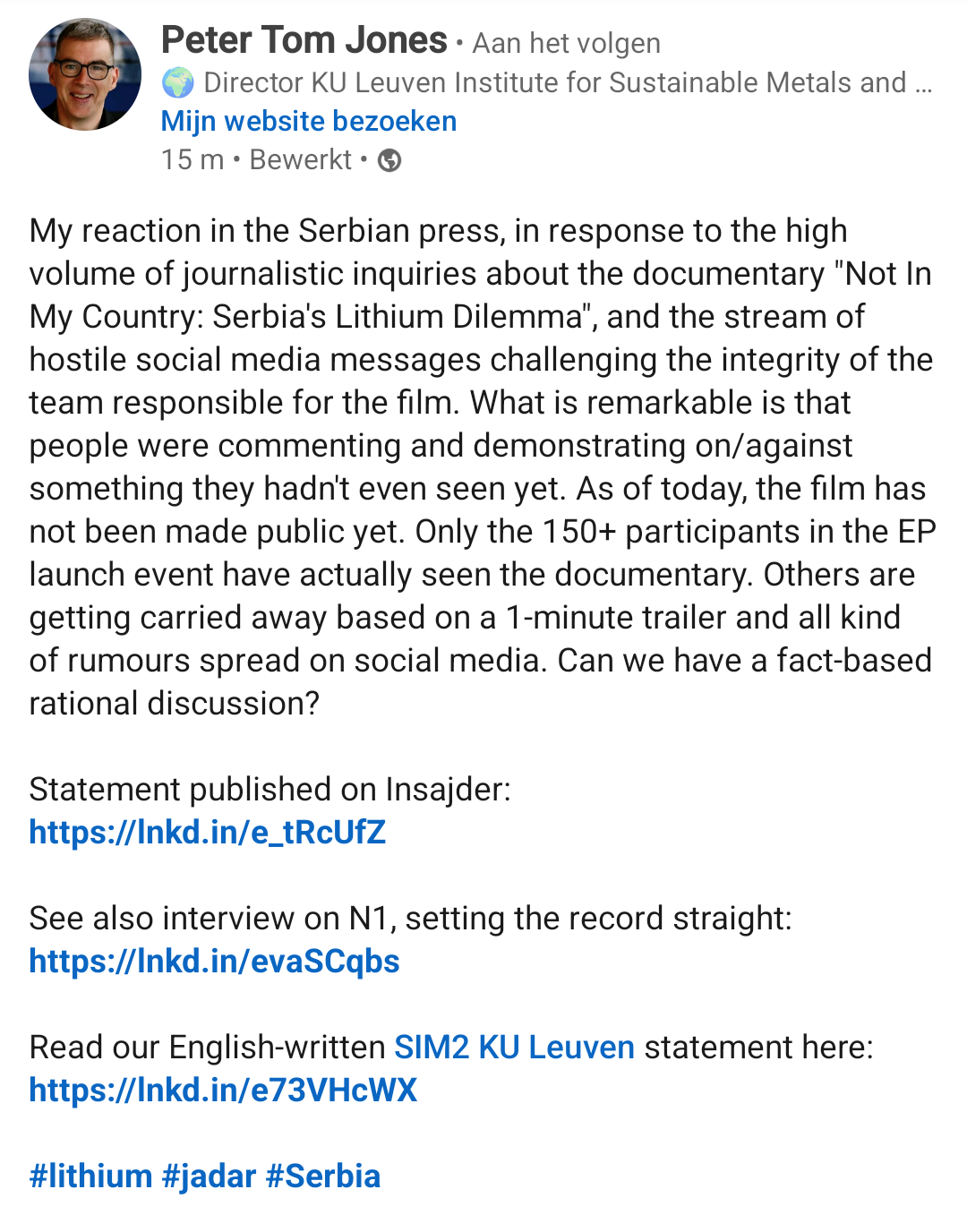
A public LinkedIn post by the director on February 10, 2025, in which he responds to the controversy by claiming it is based on rumours and on a 1-minute trailer, “as the film has not been made public yet” (which is remarkable, as I personally downloaded and watched it on Friday, February 7 on the website of Journeyman Pictures):
And here’s the trailer:

 Van Poesjkin tot Poetin en snel terug