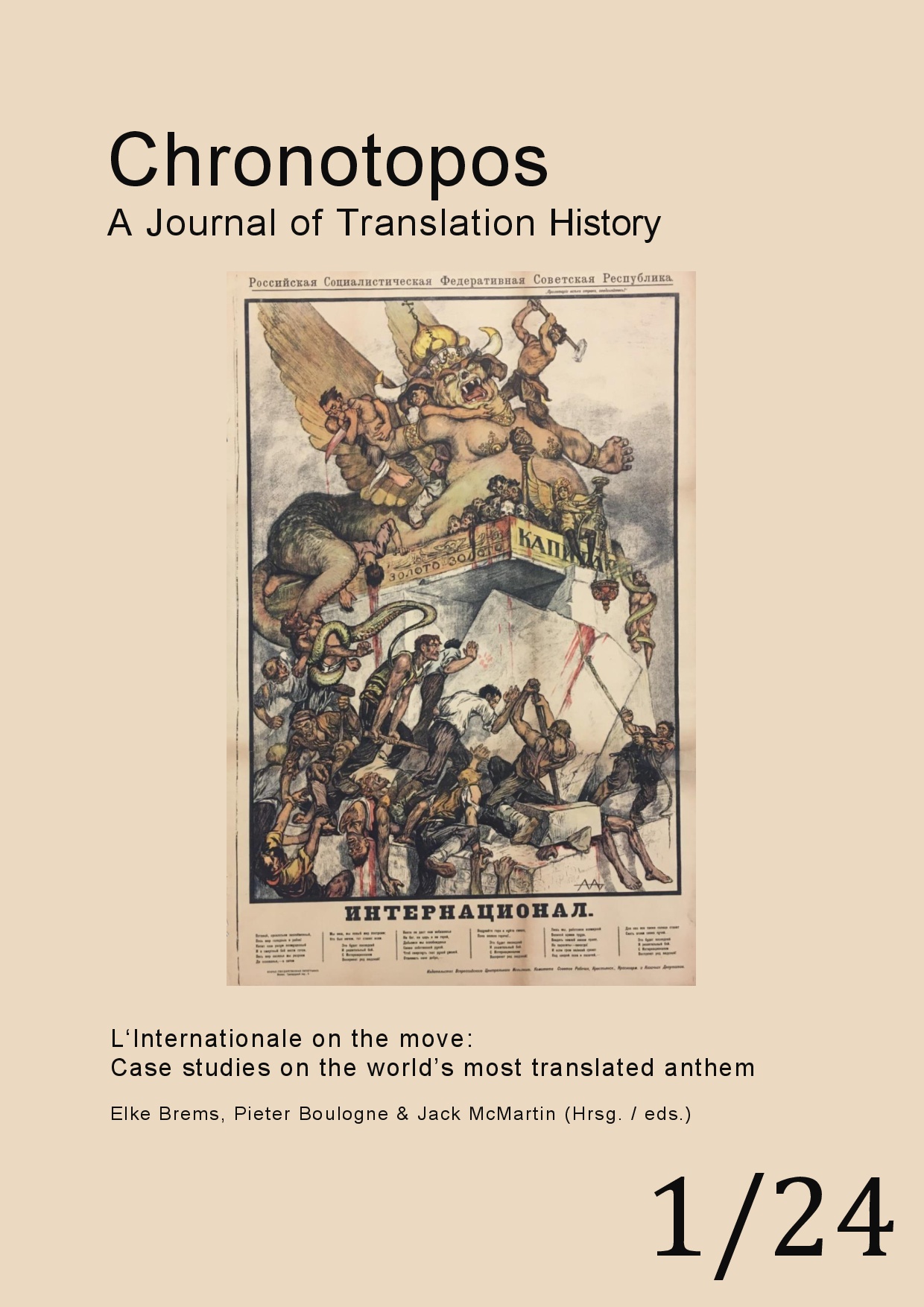
Together with Elke Brems and Jack McMartin I had the pleasure to guest edit a focus issue of the journal Chronotopos, titled “L‘Internationale on the move: case studies on the world’s most translated anthem,” which today has been published in open access.
Just over a hundred and fifty years ago, Paris was taken over by insubordinate soldiers of the National Guard. They attempted to create a new political system, a working-class community, which separated church and state, introduced social housing, abolished child labour, and gave employees the right to take over abandoned enterprises. After two months, this Paris Commune was violently ended by the French army. But the dream of addressing social injustice would not be forgotten. Immediately after the defeat of the Commune, one of its members, Eugène Pottier, commemorated it in a poem, written in French, which he named “L’Internationale”. In 1888, the Belgian socialist and composer Pierre De Geyter set Pottier’s poem to music. “L’Internationale”, previously a poem, was (re)born a song.
If the song “L’Internationale” has since become and still is a worldwide symbol of social struggle, it is because it was translated and often retranslated into dozens of languages and made to serve in many contexts. Our focus issue presents new research on versions of “L’Internationale” in different languages, historical contexts, social settings and media and explores the transnational and transmedial links between them. In doing so, we want to demonstrate how insights from (song) translation studies, reception studies, cultural memory studies and social history can be combined productively to explore the worldwide circulation and myriad social uses of one of the world’s most iconic, impactful and widely translated songs.
My own article, titled “Translated by Arkadiy Kots” Weaponization, Consecration, Monumentalization and Reincarnation of the Russian “Internationale”, deals with the impact of Arkadiy Kots as the translator of “L’Internationale” on Russian society. His Russian song translation, which emerged as a product of the counterculture, was first weaponized by Lenin to motivate workers to engage in the Russian Revolution. Then, it became the object of consecration: it was made the first anthem of the Soviet Union. However, with the passing of time, the song became an ideological and diplomatic issue, which under Stalin was solved by its monumentalization. As an established monument, Kots’s translation remained a fixture in Soviet culture until the very collapse of the empire. It is obvious that the failure of the Soviet experiment heavily damaged Kots’s cultural value. Nevertheless, his song translation remains present in post-Soviet Russia as the anthem of the Communist Party of the Russian Federation. At the same time, Kots also serves as an inspiration for the protest band that under his name has translated “L’Estaca”, which, as the most popular protest song of our time, could be seen as a reincarnation of “L’Internationale”.
These are the other articles included in our special issue:
On Wednesday 12 March 2025, Aleksandr Skorobogatov, the Belgian writer of Belarussian origin and Russian expression, was awarded an honorary medal from my university by Professor Luc Sels, our rector.
On this occasion, I had the pleasure to deliver a laudation on Skorobogatov’s works of fiction, followed by a laudation by Professor Martin Kolrausch, who focused on his merits as a columnist. The whole ceremony was in Dutch, but the KU Leuven Forum on Central and Eastern Europe now has translated our speeches into English.
I began with a reference to Isaac Babel, who brilliantly thematized the struggle to become a writer.
Ladies and gentlemen, dear colleagues, students, but most of all:
Esteemed Aleksandr Skorobogatov,
“To be in Tiflis in spring, to be twenty years old, and not to be loved—that is a catastrophe. Such a catastrophe befell me.” Such are the opening words of the short story My First Fee. For clarity’s sake: not written by Skorobogatov, but by Isaac Babel, the Jewish-Russian writer from Odessa.
At first glance, these words seem to express the protagonist’s lack of love, as he shares a house with a newlywed couple. But if you read carefully, between the lines, you realize they speak of his irresistible urge to become a writer—and his frustration that he is not one. Not yet. But how the hell does one become a writer? Babel’s story teaches us that having good material in mind is not enough. It also has to come out—and for that, you need to master various techniques. You must know which words to choose, what information to give the reader, at what moment, and what to withhold. The art of transforming fabula into syuzhet is what separates a wannabe writer from a true writer. This art does not simply come to you; it must be acquired.
“To be in Tiflis in spring, to be twenty years old, and not to be loved—that is a catastrophe.” In Babel’s story, the narrator manages to overcome the catastrophe thanks to his perseverance, a great deal of courage, and his inventiveness. And most of all, thanks to his first reader—the one who inspires and motivates him. Because a writer without an audience is a Don Quixote.
Today, I want to paraphrase Babel’s opening line, his aphorism, and say: To be a Russian-speaking writer and to find yourself in exile—that is a catastrophe. Such a catastrophe befell Aleksandr Skorobogatov.
Not even twenty, while studying at the Theater Institute in Minsk, he felt the call to be a writer. In the suffocating context of Soviet censorship, that was easier said than done. A deep ideological chasm separated him from Soviet publishers, forcing him to write for the drawer—i.e. with no prospect of immediate publication.
In 1985, during the first year of perestroika, fate was on his side: he was admitted to Litinstitut, the prestigious Gorky Institute of Literature. After completing his studies, he worked as a journalist while continuing to write. In 1989, he broke through as a literary author with the publication of his story Palatch (The Executioner) in the renowned Soviet literary magazine Yunost. The story was so well received that the magazine asked him for another one.
The story Skorobogatov submitted was the phenomenal novella Sergeant Bertrand, about an Afghan War veteran who is loved by his wife, believes he loves her too, but falls prey to blind jealousy. The unreliable, deranged narrator is reminiscent of Gogol’s Diary of a Madman and many of Dostoevsky’s characters, who are engaged in an existential struggle with themselves and with the entire world. In the case of Skorobogatov, this struggle was so dark, that Soviet censors felt the need to impose modifications. But the young and proud writer refused to accept them. Against all odds, the story got published anyway. And it won the award for the best novel of the year 1991.
1991 was—as you know—the year the Soviet empire collapsed, ushering in the turbulent 1990s. For Russian-speaking writers, these years were a catastrophe, both economically and creatively. Censorship had been abolished, but dissidents had lost their raison d’être, and the book market was flooded with pulp fiction.
In 1992, Skorobogatov, together with his novella, ended up in the Dutch-speaking world. Ever since, he has been living and working in Antwerp.
A writer ending up in a country where he does not speak or write the language—that is, obviously, a catastrophe. Even without exile, there is a fundamental incompatibility between society and the artist. In exile, far from their readership and far from Russia—a place about which one can say many things, but not that it lacks inspiration—most Russian-speaking writers feel too miserable (or too comfortable) to write. Yet writing is their entire identity.
To take another job would be to abandon the calling. (A century ago, in Babel’s time, many Russian émigré writers became taxi drivers in Paris.)
One could, of course, switch languages. But not everyone was raised, as the nobleman Nabokov, “a perfectly normal trilingual child”.
There is another solution—one we find particularly honorable. It is a solution of which Skorobogatov is a remarkable example: translation. Thanks to translation, on Belgian soil, Skorobogatov has not only managed to remain a Russian-speaking writer, but also to become a Belgian writer—one who weaves his Belgian experiences into his novels and speaks also to a Belgian audience.
On Belgian soil, Skorobogatov has written and published five new books, each of which is a testament to his unmistakable gift for storytelling.
In 1994, his novel Audiëntie bij de vorst (Audience with the Prince) was published. It sets primarily in Antwerp, but is populated by Russian characters—such as the criminal protagonist Nikita, who is morbidly obsessed with the boy Sanya.
His next novel, Earth Without Water, written between 1996 and 2001 in Moscow and Antwerp—and published in Dutch translation in 2002, under the title Aarde zonder water—carries a similarly thriller-like atmosphere: what begins as a romantic escapade spirals into an assassination and a murder.
In 2015, Skorobogatov published Portrait of an Unknown Girl, about two teenagers experiencing young love in the alcohol-drenched Belarusian Soviet Republic.
In 2017, Cocaine appeared—a novel true to its name, as it’s a trip. The narrator is an exhausted man who is sent by his wife to buy baby formula. From that moment, he hurtles forward like a whirlwind. And the reader rushes along, hypnotized, without even knowing why. Eventually, it turns out we are searching for his former sweetheart.
In 2020, Skorobogatov completely reinvented himself with The Raccoon (in Dutch: De wasbeer), a hefty novel composed of short chapters, chronicling the hilarious misadventures of a gentle raccoon, who seems to be a modern reincarnation of Akaky Akakievich, the main character of Gogol’s Overcoat. The creature embarks on an absurd odyssey and becomes the bravest version of itself.
The universe of these books, whether they are set predominantly in Russia or not, is thoroughly Russian, even if the Russian couleur locale is sometimes made into a caricature. In the novel Cocaine, for example, we encounter bearded men with bowl haircuts who drink tea from a samovar, and “chatter their teeth while biting into a yellowish sugar cone, half of which is wrapped in a piece of newspaper.” The narrator exclaims: “Never in my life have I seen muzhiks looking more Russian than them, not even on TV!”
Skorobogatov’s universe is often absurd—even chairs can burst into laughter. But above all, it is dark, bleak, and violent. This is not necessarily due to the Russian setting. In Earth Without Water, the protagonist flees, but emigration offers no solace. In the end, he concludes that everywhere you go, you have “the same underground world beneath your feet, with all the scum that inhabits it.” Addressing the reader, he asks: “Tell me, where is the guarantee that in America, Asia, Africa, Australia, Canada, and so on, the disgust will be any less nauseating than in Europe, which already sickens me, or in the utterly criminal Russia?”
The darkness of this universe is entirely linked to the author’s view of humanity. This earthly realm is populated by malevolent villains, possessed people, with twisted minds, and naïve fools or weaklings who fall into their traps and are shamelessly exploited. More than once, they pay for it with their lives.
Even love, the cornerstone of Skorobogatov’s literary universe, is dark. It is not rational. Sometimes it is paid for, sometimes it is for free. Sometimes it is homosexual, usually heterosexual—but above all, it is intensely sexual. It is the mortal enemy of monotony: love is passionate, illusory, jealousy-inducing, maddening, all-consuming, and often destructive—yet Skorobogatov’s characters cannot live without it. Not even when they are a raccoon.
Ladies and gentlemen, dear readers, I take this opportunity to warn you about Skorobogatov’s narrators, who are not any better than his most villainous characters. They are not to be trusted in the slightest. Yet we forgive them easily because they speak to us—figuratively and literally—playing tricks on our senses and intellect, blurring the boundary between fiction and metafiction. They create worlds for us, where, despite or perhaps because of the violence, we gladly linger—to purify ourselves, to rediscover traces of Russian literary classics, to listen to sharp philosophical reflections, or simply to enjoy delightful rambling—to which we are generously treated as well.
The novels mentioned above share another common trait: they have all been translated into Dutch by Rosemie (or Rose-Marie) Vermeulen, to whom Skorobogatov owes his voice as a Dutch-language prose writer.
What makes Skorobogatov’s authorship exceptional is that the publication of the Dutch translations of his books—in which he is closely involved—does not always follow the publication of the corresponding Russian originals, but sometimes precedes it. Some of his novels do not yet exist in book form in Russian. Not yet.
To the Russian writer Bulgakov, to whom Skorobogatov is sometimes compared, we owe the catchphrase “Рукописи не горят”. The saying is ambiguous: it means both “Manuscripts do not burn” and “Manuscripts are in no hurry”. Sometimes circumstances must change before a book finds its moment.
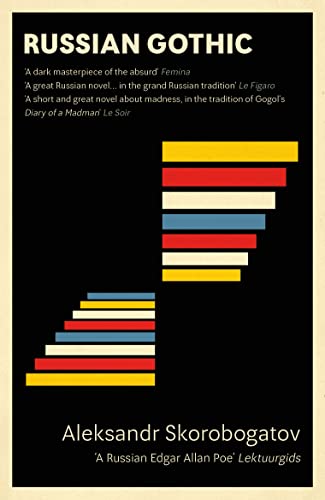
Besides Dutch and Russian, his work has been published in French, Italian, Greek, Spanish, Danish, Croatian, and Serbian. Recently, English was added to that list. More than three decades after the Russian publication of Sergeant Bertrand—at a time when countless traumatized war veterans are once again blending into Russian society—this novella has now been translated into English under the title Russian Gothic. Given the enthusiastic reception by English and American critics, this will surely not be his only English translation. In this sense, we are witnessing the birth of Skorobogatov, through translation, as an English-language author.
We also look forward to the novel that Skorobogatov recently completed, which will be published in September 2025 under the title Achter de donkere wouden (Beyond the Dark Forests), about his son, who in 2002 was kidnapped and murdered near Moscow.
Dear Aleksandr Skorobogatov,
At the Faculty of Arts, the study of cultures, languages, translation, and both ancient and contemporary history, is at the heart of our mission. Our research and teaching are rooted in our curiosity about our own culture and society, and other cultures and societies—including the Russian one. We seek to study them, to understand them, but also to experience them in depth. Your books help us with that, and they do so in an inimitably engaging way.
Your body of work has enriched not only Russian-language literature but also, to an equal extent, Dutch literature. For the way you transport your readers to Belarus, Russia, and places we never knew existed—and which, without your imagination, could not exist—we are deeply grateful. We also recognize your unique embodiment of the irreplaceable role that translation plays in the circulation of literature across cultural, national, and linguistic boundaries. For that reason, we wish to present you with an honorary medal today.
There’s more: despite the morbidity of your literary universe and the horrors of Russian domestic and foreign politics, you have not succumbed to cynicism, nor have you fallen into the trap of depoliticization. In Cocaine, the narrator states that a writer’s primary duty is to “be a nurse for society, striving with all one’s might to care for its mental health.” But to discuss the way you handle this, I will gladly hand over the floor to Martin Kolrausch, our professor of European political history.
Here you’ll find the English version of the laudation delivered by Professor Kolrausch.

 Van Poesjkin tot Poetin en snel terug